
prismAId
Open Science AI Tools for Systematic, Protocol-Based Literature Reviews
Run systematic literature reviews with generative AI: transparent, reproducible, and verifiable against reporting standards — with no coding required.
prismAId screens, acquires, converts, and extracts data from scientific literature, and lets you check the result against reporting protocols such as PRISMA 2020. It is Open Science first: every step is built to be shared, reproduced, and machine-checked against public standards.
Get started · Use it from an AI agent · Source on GitHub
 · Free and open source under AGPL-3.0
Why prismAId
prismAId is built for Open Science, and every feature serves that goal:
- Open by design — free and open source under AGPL-3.0, archived on Zenodo, and usable with no coding skills, so anyone can run and reproduce a review.
- Reproducible — each review is defined by shareable configuration files and cumulative RevAIse records, so any researcher can rerun or continue an analysis, even across institutions.
- Verifiable against standards — conformance to reporting protocols such as PRISMA 2020 is decided by machine-checked SHACL shapes, not asserted by the model. It is a reproducible claim, not a promise — and you can see a protocol’s full requirement checklist before you start.
- Accessible everywhere — drive the whole toolkit from an AI agent, the command line, a web form, or Go/Python/R/Julia.
- Current — supports the latest models from OpenAI, Google, Anthropic, Cohere, DeepSeek and others, plus cloud and self-hosted endpoints.
Quickstart
With an AI agent. Connect an assistant to the MCP server and describe your review; it generates and validates the configuration, runs the tools, and checks conformance for you.
Or install and run directly. Install prismAId for your platform — a no-coding binary or a language package — then create a configuration with the web configurator or the -init command and run your review. See Installation & Setup.
The prismAId Toolkit
prismAId offers a suite of tools to support every stage of your systematic review:
Core Tools
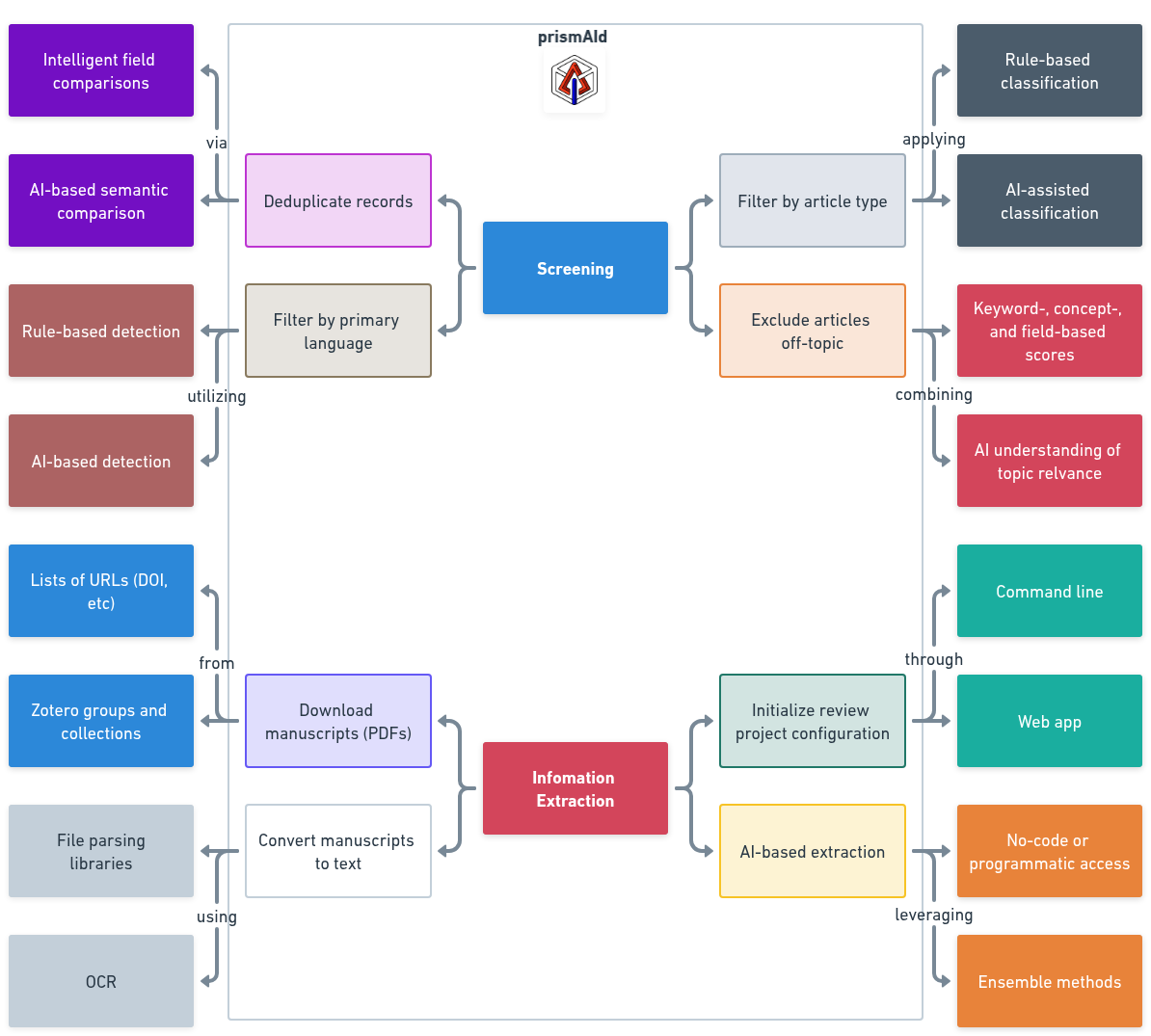
- Screening - Filter and tag manuscripts to identify items for exclusion
- Download - Acquire papers from Zotero collections or from URL lists
- Convert - Transform files (PDF, DOCX, HTML) to plain text for analysis
- Review - Process systematic literature reviews based on TOML configurations
- RevAIse documentation support - Optionally document review stages as RevAIse review records
Access Methods
prismAId can be used two complementary ways:
- Through an AI agent (MCP server) — a main entry point for anyone exploring prismAId. Connect an AI assistant to the prismAId MCP server and work in conversation: it helps you generate and validate configurations, run the tools, and check and plan for protocol conformance, exposing every capability below through one interface.
- Directly, on your platform of choice — granular, multi-platform access to the same tools:
- Command Line Interface — for terminal-based workflows
- Web Initializer — a browser-based setup tool for configuring reviews
- Programming Libraries — Go (native implementation), Python, R, and Julia packages
Workflow
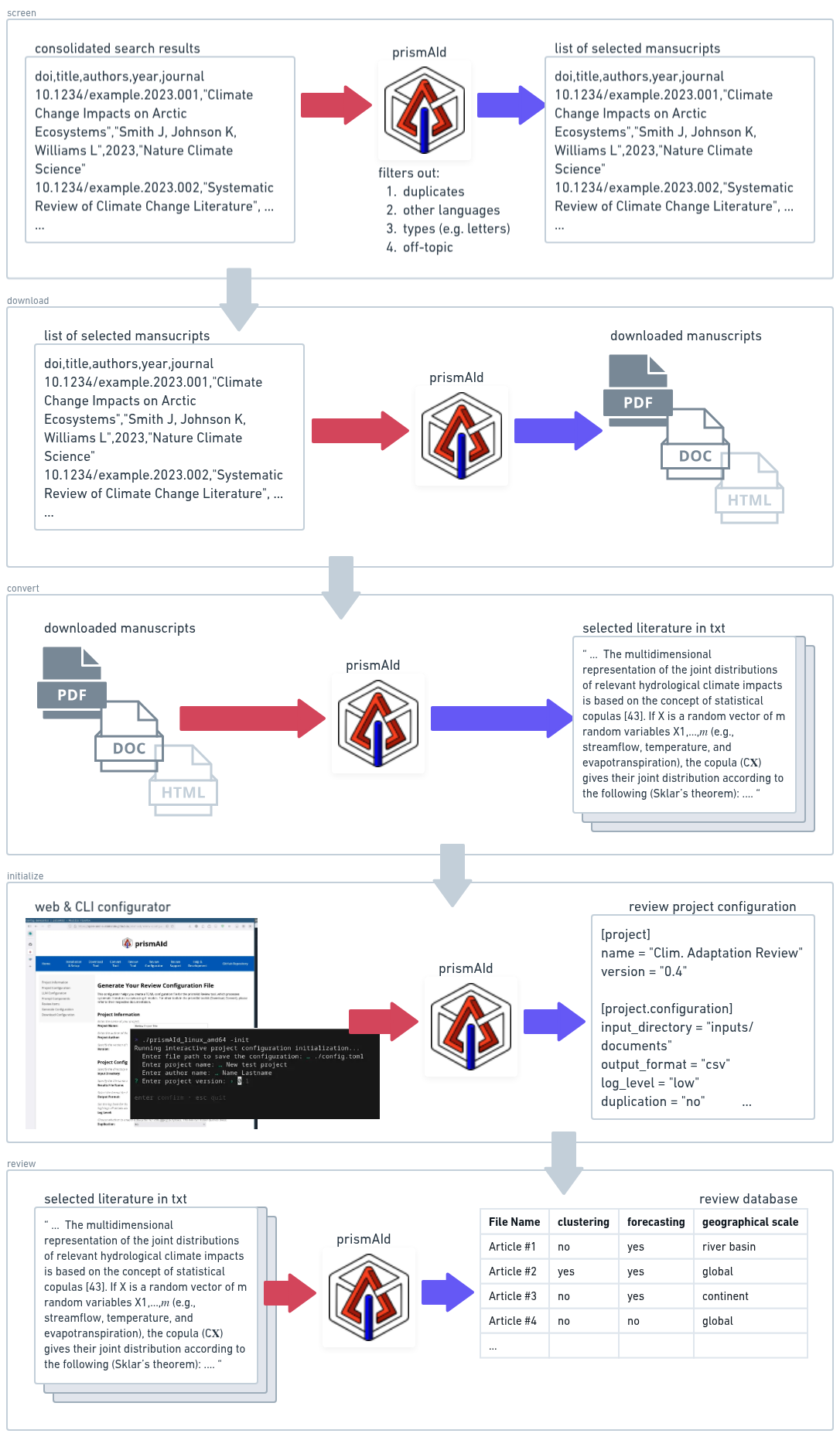
Our tools support a comprehensive systematic review workflow following the standard sequence: Search → Screen → Download → Convert → Review. Optional RevAIse support can document Zotero download, screening, and review/extraction stages in one cumulative review record.
Documentation
Get started
- Installation & Setup — install prismAId and configure it for your environment
- Recipes — short, task-oriented guides for common workflows
- MCP Server — drive the whole toolkit from an AI agent
Tools
- Screening — filter manuscripts: deduplication, language, article type, topic relevance
- Download — acquire papers from Zotero collections or URL lists
- Convert — transform PDF, DOCX, and HTML into plain text
- Review — extract structured information from the literature
Reviews & records
- Review Workflow — methodology and best practices
- Review Configurator — build a configuration in the browser
- RevAIse Integration — maintain a cumulative review record across stages
Protocol conformance
- Protocol Conformance — check a review record against a protocol such as PRISMA 2020
- Protocol Guidance — a protocol’s full requirement checklist, up front
Help & contributing
- Help — troubleshooting and FAQ
- Development — how prismAId is built and how to contribute
New Releases and Updates
Follow the Matrix prismAId Announcements Room for the latest updates and release notifications.
Credits
Authors
Riccardo Boero - ribo@nilu.no
Acknowledgments
This project was initiated with the generous support of a SIS internal project from NILU. Their support was crucial in starting this research and development effort. Further, acknowledgment is due for the research credits received from the OpenAI Researcher Access Program and the Cohere For AI Research Grant Program, both of which have significantly contributed to the advancement of this work.
License
GNU AFFERO GENERAL PUBLIC LICENSE, Version 3

Citation
Boero, R. (2024). prismAId - Open Science AI Tools for Systematic, Protocol-Based Literature Reviews. Zenodo. https://doi.org/10.5281/zenodo.11210796
@software{boero2024prismaid,
  author  = {Boero, Riccardo},
  title   = {prismAId - Open Science AI Tools for Systematic, Protocol-Based Literature Reviews},
  year    = {2024},
  doi     = {10.5281/zenodo.11210796},
  url     = {https://doi.org/10.5281/zenodo.11210796}
}